
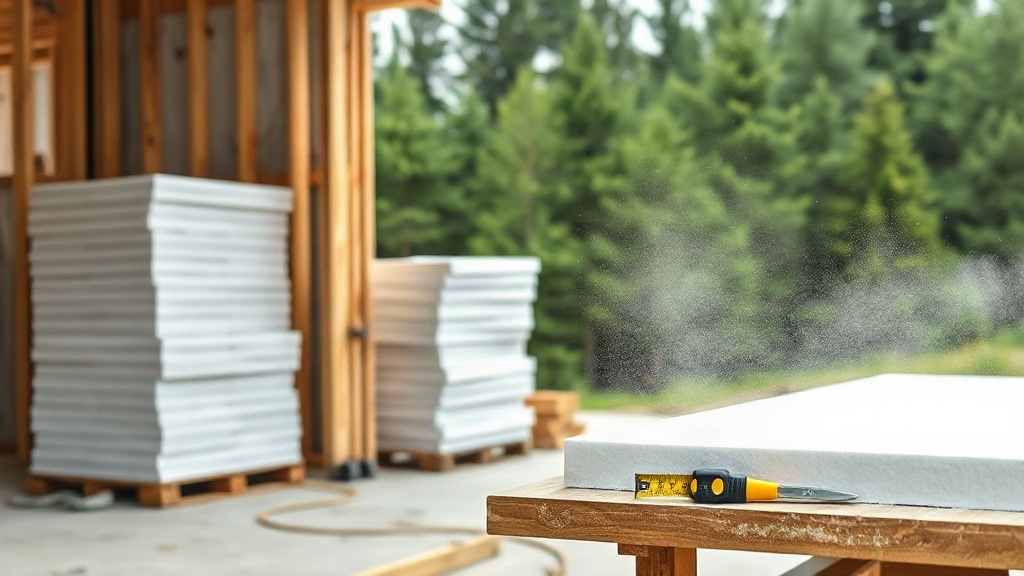
Ask ten contractors what EPS insulation is and you will get ten versions of the same answer: white foam board, cheap, gets the job done. That answer is not wrong, but it hides everything that actually matters. Expanded polystyrene is one of the most forgiving insulation products on the market, and that forgiveness is exactly why it gets installed badly so often. A board that shrugs off a sloppy cut on one job will quietly underperform on the next, and nobody notices until a homeowner complains about a cold room or a heating bill that will not come down.
This guide is about the parts of EPS insulation work that do not show up on a spec sheet: how the material behaves in real assemblies, where it fits better than its competitors, and the installation habits that separate a job that performs for thirty years from one that performs for five.
What EPS Insulation Actually Is
Expanded polystyrene starts as small beads of polystyrene resin. Those beads are exposed to steam in a pre-expander, which makes them puff up to roughly forty times their original volume. After a short curing period, the expanded beads go into a mould where more steam fuses them together into a block. That block is then cut into sheets with hot wires, which is why EPS insulation boards can be produced in almost any thickness or custom shape without retooling.
The fused-bead structure is the whole story of how the material performs. Between the beads there are tiny voids, and inside each bead there are closed cells filled with air. Heat has to travel through a maze of polystyrene walls to get from one face to the other. That structure gives EPS its predictable thermal performance, its ability to dry out after wetting, and its reputation for being the least fussy rigid foam on a construction site.
R-Value Per Inch and Why the Number Moves
Standard Type 1 EPS insulation runs around R-3.6 to R-3.8 per inch at 75°F mean temperature. Higher-density Type 2 boards push closer to R-4.2 per inch. Those numbers are lower than polyisocyanurate, which sits near R-6 per inch, and lower than extruded polystyrene at roughly R-5. The gap matters when you are fighting for every inch of wall thickness.
What many installers miss is that R-value is not a fixed constant. As mean temperature drops, EPS performance drops with it, but more slowly than some other foams. That is why a thick EPS wall in a Canadian climate often performs closer to its rated value across a heating season than a thin, high-R board that was specified on a summer afternoon.
Where EPS Insulation Earns Its Place
There is no single best insulation product, only best fits. EPS tends to win in a few specific situations.
- Exterior sheathing on wood-frame walls, where you want continuous insulation without breaking the bank.
- Below-grade applications, including foundation walls and slab edges, because EPS tolerates damp conditions and does not trap water against concrete.
- Insulated concrete form cores, where the beads are moulded directly into the form.
- Roof decks under membrane, particularly in low-slope assemblies where compressive strength and cost both matter.
- Custom shapes, since hot-wire cutting makes tapered and profiled boards straightforward.
Where EPS struggles is in tight spaces. If you only have two inches of cavity to work with, you may need a higher-R product to hit code. If you need the highest possible R-value in a thin envelope, mineral wool or polyiso will usually beat it.
Moisture, Freeze-Thaw, and the Myth of the Sponge
The most persistent complaint about EPS insulation is that it soaks up water. This is only partly true, and the distinction matters. The fused beads themselves are closed-cell and do not absorb water. Moisture moves between the beads through capillary action and through gaps left by poor fusion or damaged board edges.
In practice, a well-made EPS board picks up very little water even after long exposure. More importantly, it gives that water back. When a wall dries inward or outward, EPS releases moisture rather than holding it against the sheathing. That drying capacity is a genuine advantage in Canadian assemblies, where walls spend months cycling between wet and dry.
The real risk is not the foam itself but what happens around it. If you install EPS over a wet substrate and seal it with a low-permeance membrane, you have built a wall that cannot dry. The foam is not the problem. The assembly is.
Freeze-Thaw Behaviour
EPS has been used in below-grade and exterior applications in cold climates for decades, and freeze-thaw damage to the foam itself is rare. The beads flex slightly with temperature change, and the material does not become brittle the way some rigid foams can. The bigger concern is frost heave on the soil side of a foundation, which is a drainage problem, not an insulation problem.
Installation Details That Decide Performance
You can buy the right board and still lose half its value in the first afternoon of installation. These are the details worth slowing down for.
Board Fit and Gaps
Gaps between boards create thermal bridges. A quarter-inch gap running the full height of a wall is a direct path for heat to escape, and it also becomes a condensation point in winter. Cut boards tight, stagger joints, and use canned foam or a compatible sealant in any gap wider than about an eighth of an inch.
Fasteners and Washers
Every screw or nail that passes through EPS insulation is a small bridge. Use fasteners with plastic washers designed for foam, and set them flush rather than over-driven. Over-driving crushes the board, reduces thickness, and creates a dimple that collects water.
Air Sealing Before Insulating
Rigid foam is not an air barrier on its own unless the joints are taped and the perimeter is sealed. Air leakage moves far more heat than conduction in a typical wall, so seal the sheathing seams, the top and bottom plates, and every penetration before you call the insulation done.
Vapour Control Placement
In heating-dominated climates, the vapour control layer usually belongs on the warm side. Adding exterior EPS insulation raises the temperature of the sheathing, which reduces the risk of condensation inside the wall. Get the ratio of exterior to cavity insulation wrong, though, and you can create a cold interior surface that condenses. This is where a building science consultant earns their fee.
EPS Insulation Compared With XPS and Polyiso
Choosing between the three rigid foams comes down to four variables: R-value per inch, moisture behaviour, compressive strength, and cost.
- XPS has higher R-value per inch but is denser, more expensive, and its blowing agents have a higher global warming potential than EPS in most cases.
- Polyiso offers the highest R-value per inch at moderate temperatures, but its performance drops noticeably in cold weather, which matters in Canada.
- EPS sits in the middle on R-value, wins on cost, performs consistently across temperatures, and dries out readily.
For most residential and light commercial work in a cold climate, the cost-per-R and the drying behaviour of EPS make it the practical choice. Where you need maximum R in minimum thickness, polyiso still wins, but you should account for its cold-weather derating.
Common Mistakes That Undo Good Work
These show up again and again on site visits.
- Leaving EPS exposed to UV for months. Sunlight degrades the surface, and the board becomes chalky and brittle. Cover it or specify a UV-resistant facer.
- Using the wrong adhesive. Solvent-based products can attack polystyrene. Stick to water-based or specifically approved adhesives.
- Compressing boards to force them into an uneven cavity. Compression reduces R-value and stresses the fasteners.
- Skipping the air barrier because the foam looks tight. It is not.
- Ignoring the thermal bridge at floor joists and rim boards, which is often the worst-performing part of the whole assembly.
Frequently Asked Questions
How much R-value does EPS insulation have per inch?
Standard Type 1 boards deliver roughly R-3.6 to R-3.8 per inch at typical service temperatures. Higher-density Type 2 boards reach about R-4.2 per inch. The exact figure depends on density, temperature, and moisture content over time.
Does EPS insulation absorb water and lose R-value?
The beads are closed-cell and do not absorb water, though moisture can move between them. Well-made EPS takes on very little water and dries out readily. Prolonged saturation will reduce R-value, which is why drainage and air sealing matter more than the foam itself.
Can EPS insulation be used below grade?
Yes. EPS is widely used on foundation walls, slab edges, and under slabs. It handles damp conditions well and does not trap water against concrete, provided the assembly includes proper drainage and a suitable protection board.
Is EPS insulation suitable for cold Canadian winters?
Yes. EPS retains its performance across a wide temperature range and does not become brittle in cold weather. The key is detailing the assembly correctly, including air sealing and vapour control, so that the foam is not asked to compensate for a flawed wall design.
How does EPS compare to XPS for exterior sheathing?
XPS offers slightly higher R-value per inch and higher compressive strength, but costs more and does not dry as readily. EPS is usually the better value for continuous exterior insulation where drainage and drying are already handled by the rest of the assembly.