
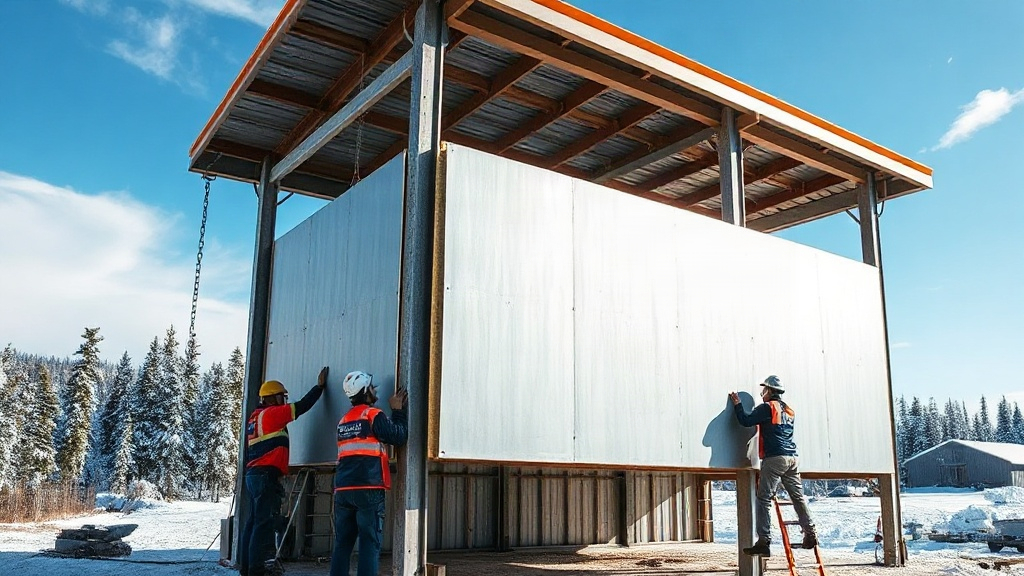
When you're on a job site in Canada, the success of your building envelope often hinges on the sandwich panels you choose and how you install them. Panel Installation & Specs aren't just technical details; they determine energy efficiency, structural integrity, and compliance with Canadian building codes. Whether you're retrofitting a warehouse in Ontario or putting up a cold storage facility in Alberta, understanding the nuances of panel specs and installation can save you time, money, and headaches.
Understanding Sandwich Panel Specifications
Sandwich panels consist of an insulating core sandwiched between two metal skins. The specs that matter most are core material, thickness, density, and fire performance. In Canada, the National Building Code (NBC) and provincial codes set strict requirements, especially for fire safety and energy efficiency.
Core Materials: PIR vs. Mineral Wool vs. EPS
Polyisocyanurate (PIR) offers excellent thermal performance with an R-value around 6.5 per inch, making it a go-to for many commercial projects. Mineral wool, on the other hand, provides superior fire resistance and sound insulation, ideal for schools or high-occupancy buildings. Expanded polystyrene (EPS) is cost-effective but has lower fire resistance and R-value (about 3.8 per inch). Your choice depends on budget, building use, and local fire codes.
Thickness and R-Value: Getting the Numbers Right
Panel thickness typically ranges from 50 mm to 200 mm. For Canadian climates, you'll want to aim for an R-value that meets or exceeds the requirements of the National Energy Code for Buildings (NECB). For example, a 100 mm PIR panel gives roughly R-26, while 150 mm mineral wool provides about R-21. Always check with your local authority having jurisdiction (AHJ) for minimum R-values in your area.
Fire Ratings and Code Compliance
Fire safety is non-negotiable. Look for panels with a flame spread rating of 25 or less and a smoke developed classification of 450 or less per ASTM E84. Mineral wool panels often achieve non-combustible ratings, which can be critical for certain occupancies. In Canada, CAN/ULC S101 fire resistance tests are standard. Ensure your panels carry the appropriate certification for your building type.
Installation Best Practices for Canadian Conditions
Installing sandwich panels correctly is as important as choosing the right specs. Canadian weather throws curveballs: freeze-thaw cycles, high winds, and heavy snow loads. Here's how to tackle common challenges.
Pre-Installation Checklist
- Verify panel dimensions and quantities against shop drawings.
- Inspect panels for damage during shipping; even minor dents can compromise seals.
- Ensure all flashing, trims, and fasteners are on site and match the panel system.
- Check that the substrate (e.g., steel purlins or girts) is straight, level, and securely fastened.
Step-by-Step Installation Tips
- Start at the leeward corner: Begin installation at a corner away from prevailing winds to minimize wind uplift during the process.
- Align and clamp: Use panel lifting clamps and align the first panel perfectly; subsequent panels follow its lead.
- Fasten correctly: Drive self-drilling screws through the panel's high rib (for trapezoidal profiles) or into the concealed clip (for concealed-fix systems). Avoid over-tightening, which can crush the core.
- Seal joints: Apply butyl tape or silicone sealant between panels to prevent water infiltration. In Canada, where freeze-thaw cycles are common, use a sealant rated for low-temperature flexibility.
- Install flashings immediately: Don't leave exposed edges; install flashings as you go to maintain weathertightness.
Dealing with Thermal Bridging
Thermal bridging occurs when fasteners or structural members conduct heat through the insulation. To mitigate, use thermal breaks such as nylon washers under screw heads or choose panels with integrated thermal breaks. This is especially important for cold storage facilities where every bit of energy savings counts.
Snow Load and Wind Uplift Considerations
Canadian building codes specify ground snow loads that vary by region. Your panel system must be engineered to withstand these loads, often requiring additional supports or thicker panels. Similarly, wind uplift can be significant in coastal areas; ensure fasteners are spaced per engineer's recommendations and that panels have a high pull-out strength.
Common Mistakes to Avoid
Even seasoned installers can slip up. Here are pitfalls to watch for:
- Ignoring expansion and contraction: Panels expand and contract with temperature changes. Provide adequate clearance at edges and use slotted holes where needed.
- Using incompatible sealants: Some sealants react with panel coatings. Always test a small area first.
- Poor storage: Store panels off the ground, under cover, and with proper ventilation to prevent condensation and rust.
- Skipping quality checks: After installation, inspect for loose fasteners, gaps, and sealant integrity.
Frequently Asked Questions
What thickness of sandwich panel do I need for a cold storage facility in Canada?
For cold storage, you typically need thicker panels to achieve higher R-values. A minimum of 150 mm PIR or 200 mm mineral wool is common, but consult a structural engineer to meet specific temperature and load requirements.
Can I install sandwich panels over existing cladding?
Yes, but you must ensure the existing substrate is sound and can support the additional weight. You may need to add purlins or girts to provide a level mounting surface.
How do I handle panel joints to prevent leaks?
Use a combination of butyl tape and a high-quality sealant. Ensure joints are clean and dry before sealing. For concealed-fix systems, rely on the panel's interlocking design and proper clip installation.
What are the fire code requirements for sandwich panels in Canada?
Fire code requirements vary by province and building type. Generally, panels must meet CAN/ULC S101 for fire resistance and have a flame spread rating of 25 or less. Always check with your local fire department and building code.
How do I prevent condensation inside sandwich panels?
Proper ventilation and vapor barriers are key. Ensure the building envelope is designed to manage moisture. In some cases, adding a breathable membrane or using panels with integrated vapor barriers can help.
By paying close attention to Panel Installation & Specs, you can ensure your project stands up to Canadian weather and code requirements. For more detailed guidance or to source high-quality sandwich panels, reach out to the experts at Sandwich Panels Canada.